
a short piece I wrote about Jake and Gus…
- Follow BJ's Blog on WordPress.com
Search my blog
-
Recent Posts
My books
Follow me on Twitter
My Tweets
A quote from the last section of Grant Faulkner’s The Art of Brevity: Crafting the Very Short Story (168-169):
On Revision (and Knitting)
When knitting, you might get pretty far along with your sock before you realized you effed up and dropped a stitch. If you want your sock to look good, you are going to rip out the stitches and lose the hours you spent knitting perfectly well after you made that mistake in order to correct your error and ultimately make the sock you were born to knit. For me, writing is the same. If I take a wrong turn, I need to go back to that juncture to fix the story. Otherwise, I will have a sock, I mean, story, that has not lived up to its potential. A stupid, useless sock-story.
— Lynn Mundell
I’m struck by the parallel to a recent experience of my own: I found a skein of cotton yarn, whose label indicated it was suitable for size 1-3 mm needles, and I knitted a sock to the heel gusset three times. Each time, I dropped a stitch or lost count of the decreases then couldn’t retrieve the stitches when I undid my work. After I ripped out the sock for a third time, I decided I either needed to change the needle size or yarn weight. I found a skein of Noro sock wool–not as soft as cotton–but the weight fit the needles. The stitches were not too tight, not too loose. The gauge was just right.
Like Mundell, I couldn’t leave the mistake and carry on. Unlike Mundell, I couldn’t return to the juncture and fix it. The mistake was in the materials: the yarn, the needles, the gauge, the pattern. Something was amiss. Everything has to work together in order for the sock to live up to its potential. Rather than revising “a rip in the fabric” (yet again), I need to rip out the entire sock-story and start over. Rather than a 387-word micro essay, perhaps I need to write a 100-word story about the demise of a favorite flannel robe. Distill the sock-story to its essence.
Insightful piece in The New Yorker: The Tortured Bond of Alice Sebold and the Man Wrongfully Convicted of Her Rape. See my previous post: unlucky.
We received almost a foot yesterday–March 27th. During graduate school, I wrote a paper (long lost) about John Greenleaf Whittier’s poem, Snow-Bound: A Winter Idyl. I forgot how long the poem is, but maybe I’ll reread it and perhaps write a new essay about snow.
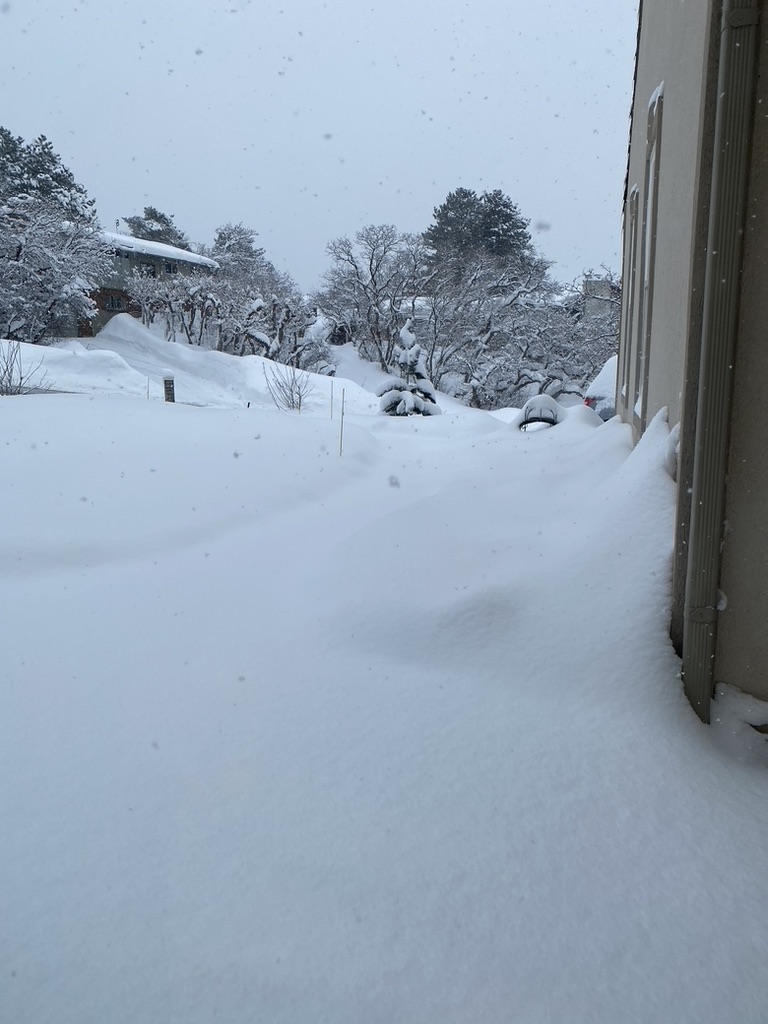
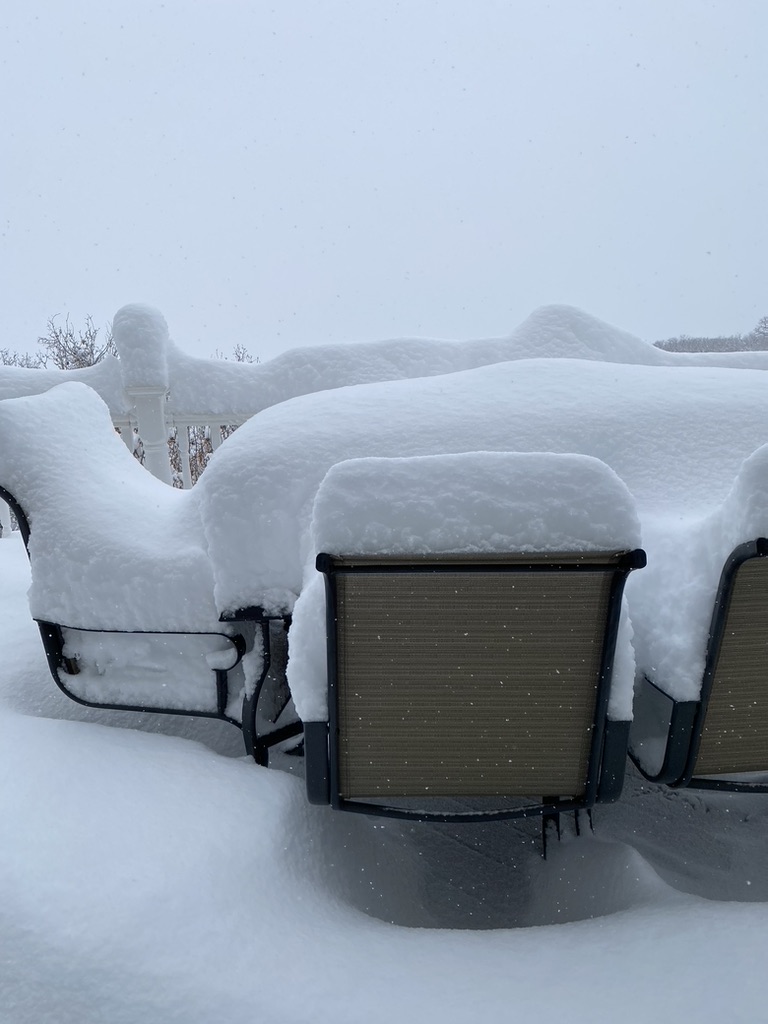
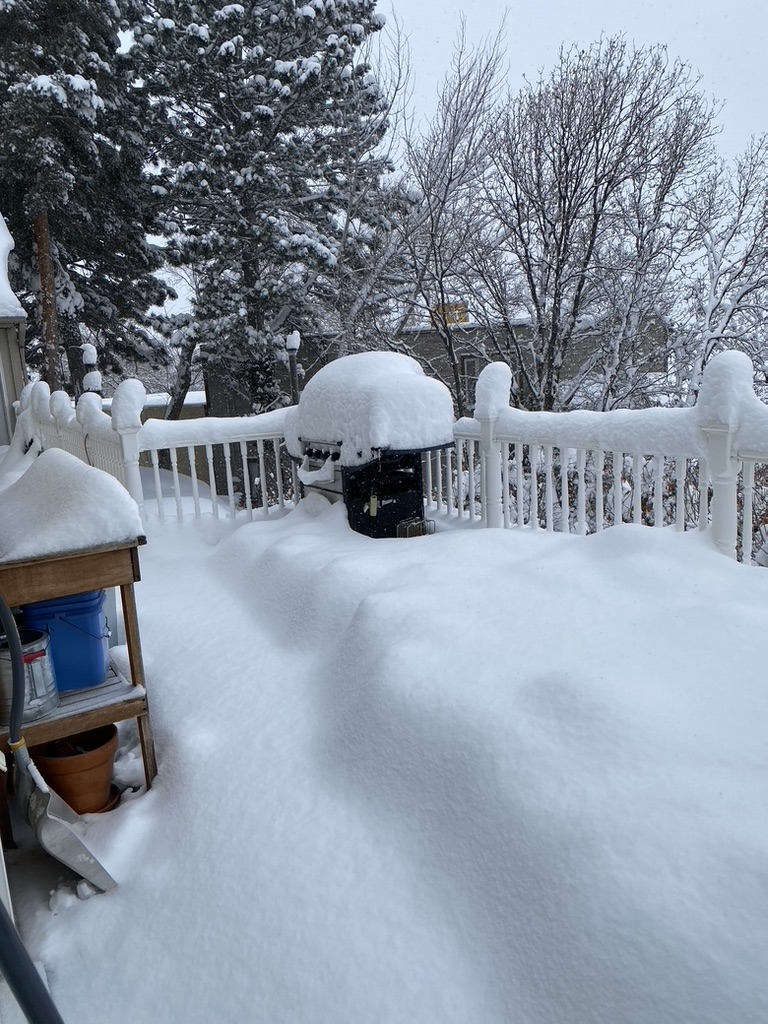
I tested positive for COVID-19 on March 5, 2023. According to recent reports, the pandemic began on March 11, 2020. I made it almost three years before contracting the virus. On March 12, I tested positive again, so on day 9 (today) I opted to stay home and teach online. After 10 days, I should be okay to venture out into the world.
Such a weird bug. I tried yoga on day 5. Big mistake. The headache returned, and I felt like crap the next day. From one day to the next, I feel energized then exhausted. From one hour to the next, I feel good then bad. From one minute to the next, I feel hot then cold. My sense of smell and taste changes throughout the day. My sinuses feel clear, they feel stuffy. I get dizzy. I get hungry, I get nauseous. I get dry mouth. I forget what I just said. I remember the lines from a song I heard 20 years ago. I wait and wait and wait for the fog to dissipate. And I eagerly await bedtime, which gets earlier and earlier every night. Daylight savings time be dammed. I can sleep anytime, anywhere.
No skiing. No southern Utah trip. No relaxing days reading books and watching movies. Instead a slog of a week. A slug moves faster and enjoys the journey.
I don’t make them. I mean I do, but then I quickly abandon them. I tell everyone I don’t make them so I don’t have to tell them I’ve already quit doing whatever I promised myself I wouldn’t do, or stopped doing whatever I promised myself I would do. Last night I fell off the wagon, which I’d only been riding for three days: Monday, Tuesday, Wednesday. By Thursday, I needed/wanted a drink.
Apparently I’m not alone. Today, January 13, 2023, is Quitters’ Day–the day when everyone quits, gives up, abandons their New Year’s resolutions. The second Friday of January is the date by which we’ve all decided it’s just too difficult to change our behavior:
“Quitter’s Day is set aside to recognize those who set new year goals and fail to achieve them — and to encourage and equip them to try again and ultimately succeed. Research has shown that people quit their resolutions for the year by the second Friday of January.”
Fascinating! I’m part of the 80%. Do I get extra points for quitting early? I didn’t plan to resolve anything. I mean I have no resolve. I really just want to survive–survive the return to teaching, the winter, the next few years of my life. Drinking, even in moderation, probably doesn’t prolong my life. But how bad is it really? I mean the battles I wage with myself may be doing more harm than the booze. Perhaps I could give myself permission to be imperfect, to have the occasional evening of whiskey or wine.
“Progress not perfection.” I exercised every day this week so far = progress. I woke up early and wrote–at least a little bit–every morning this week = progress. I kept up with my classes in person and online = progress. I made time to read a book = progress. I practiced the piano = progress. I knit a sock = progress. I skied = progress. I avoided the TV news most evenings = progress. I spent quality time with my cats, daughter, and husband = progress. I wrote and mailed thank you notes for Christmas = progress. I came to this coffee shop and wrote a post for my blog = progress.
I resolve not to worry about being the imperfect being that I am. I resolve to be enough, for now.
After owning this blog for I don’t know how many years, I’ve finally added a new page, Publications, which includes the following sub-sections:
One month away from returning to teaching, and I’m feeling okay with my accomplishments. I completed my chapbook manuscript. Here’s the synopsis:
Unraveling disentangles the strands of the narrator’s life in order to reveal a woman’s capacity to unknot pesky relationships and unsnarl nasty situations. As she unravels the troubling bits, she knits together a freshly-pressed fabric of hope, joy, and love.
And here’s the full list of stuff I did:
July
August
September
October
November
December
Classes completed
Chapbook completed
Unraveling (November)
Essays published
Residency attended
Creekside Arts (September)
You didn’t make it to 60.
I’m still in shock that you’re gone, though it’s been 2 months. Poof. Gone from the world. Nothing left. No children, no pets, no written words, very few photos and none recent, no sounds of your warm and infectious laugh, no lingering smile or mischievous grin, no witty rejoinders, no affectionate nicknames (Lux, Researcher Ray, Engineer Ed, Biology Bob), no dance moves to the Cure, no late-night chats about our love lives, no birthday emails exchanged, no visits to catch up on all the minutiae of our lives, no more hockey matches or swim meets or guys to obsess over, no more love to spread across your sphere. But perhaps I’d lost you long ago, in 1999, when you married and moved to Maine.
The slow, not so slow, march to death. I can see why Carolyn Heilbrun chose to leave early, though she delayed her departure by almost a decade. Go before someone parks you some place and you have no power to leave. If Georg was smart he’d have a plan to to end it. If he cannot function without you, however, he probably doesn’t have the means. Hard to imagine being so utterly dependent on another person. Did you like having him so vulnerable, so needy? Did it give your life purpose?
As I’m working on my own sense of purpose I imagine that having someone so reliant could at least give you a reason to get up every day. Then the equation changes: one of the components is removed. So what happens with the remaining one? Kind of a dumb analogy. But there it is. I often wonder about my parents–who will fail first, how will the other one respond–and about me and Dave. Surely a clean exit without any entanglements would be best.
All the time runs out and then it’s over 10 years since your sister-in-law saw Georg, and she has no idea how to help him. The sister says he has Stockholm Syndrome. What about you? Were you abused? Did he hurt you? Why didn’t I reach out to you more often? More than once a year for our birthdays. And maybe I should have visited, tried to be involved in your lives. So much I don’t know–and will never know–about your relationship. I can barely understand my own.
I wonder what you’d hoped to do today…were you and Georg planning a party, a trip, a dinner out?
Cause of death: obesity hypoventilation syndrome.
You couldn’t breathe. Your heart gave out.


 BJ's Blog